- Published on
Algebraic Proof of the Pythagorean Theorem
- Authors

- Name
- hwahyeon
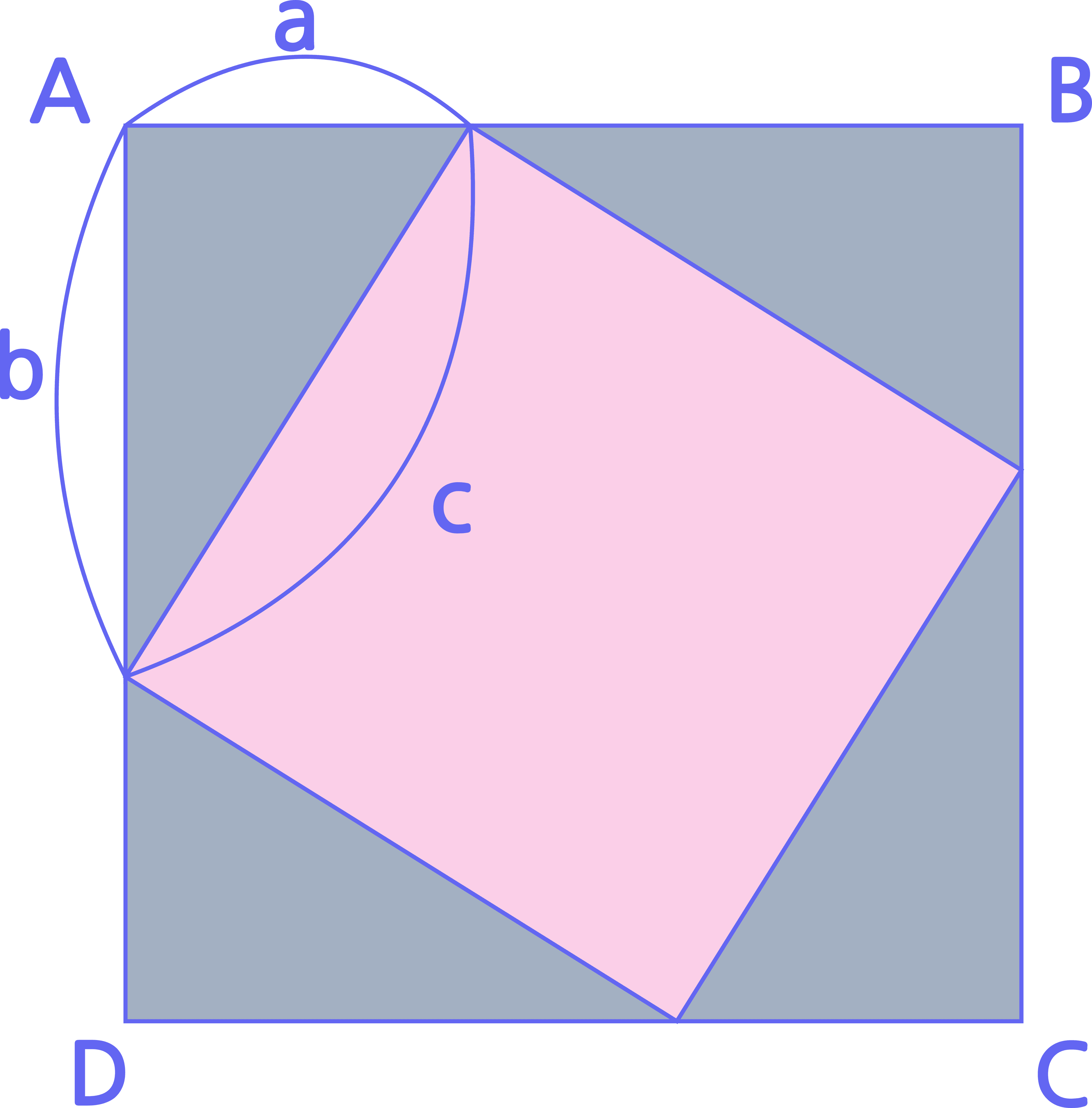
The area of square ABCD can be calculated in two ways.
The first method is squaring its side length, , giving .
The second method is adding the areas of four congruent right triangles and the central square.
Each triangle has an area of , so multiplying this by gives for the total area of the four triangles. Adding the central square’s area, , gives .
Equating the two expressions:
Simplifying yields:
which proves the Pythagorean theorem.